What are shorebirds?
Shorebirds (or waders) are principally found along the shores of beaches, estuaries, rock platforms and wetlands, where they sometimes congregate in large flocks and feed mainly on invertebrates taken from mud and other soft substrates. They include lapwings, plovers, sandpipers, godwits, curlews, snipe, oystercatchers, phalaropes and related forms in several families within the order Charadriiformes. This order also includes gulls and terns but they are not considered to be shorebirds because they exhibit quite different foraging behaviours and food preferences. Large wading birds such as herons, egrets and ibis are not closely related to shorebirds and should not be called waders. Many shorebirds specialise at taking invertebrate prey from tidal mudflats in sheltered bays and estuaries. These habitats offer abundant food at low tide but no nesting opportunities because the mudflats are inundated at high tide. Some of the most common shorebirds in Australia migrate half way round the world to nest in Arctic tundras of Siberia and Alaska, once more exploiting a rich habitat that is periodically unavailable (when it is covered by snow in the northern winter).
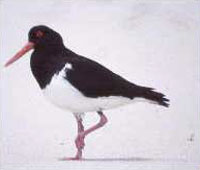
Pied Oystercatcher
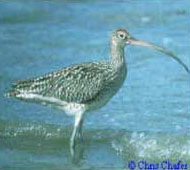
Eastern Curlew
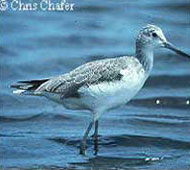
Common Greenshank
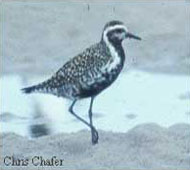
Pacific Golden Plover
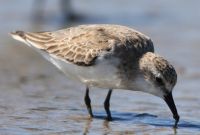
Red-necked Stint
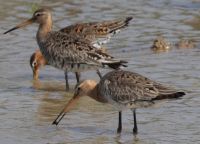
Black-tailed Godwit
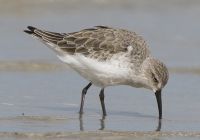
Curlew Sand
Photo 1. Examples of shorebirds
Australia has at least 76 species of shorebird((Christidis, L. and Boles, W.E. 1998. The Taxonomy and Species of Birds of Australia and Its Territories. Royal Australian Ornithologists Union, Monograph No. 2, Melbourne.)) [Table 1], while recent estimates of total Australian populations are 1.1 million for resident species and 2 million for migratory species((Watkins, D. 1993. A National Plan for Shorebird Conservation in Australia. Report No. 90. Royal Australian Ornithologists Union, Melbourne.)). Most migratory species visit Australia during the austral summer (October to March) from the northern hemisphere (Russia, China, Mongolia, Japan, North Alaska): most arrive here between August and October and depart between March and May. One species (Double-banded Plover) migrates to Australia during the austral winter from New Zealand: a few arrive here as early as February and most are present from April to September. The main trans-equatorial migration pathway is known as the East Asian – Australasian Flyway.
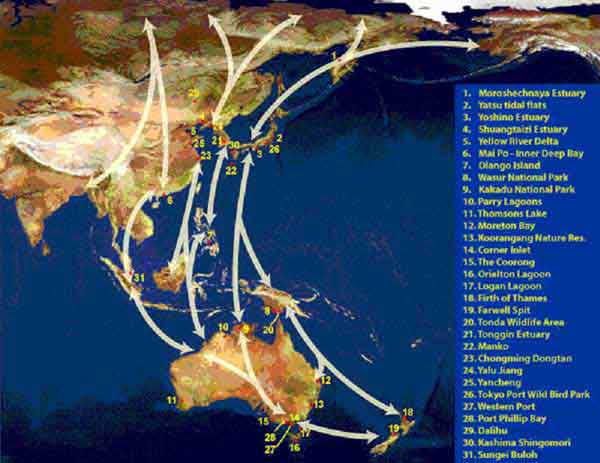
Figure 1. The East Asian – Australasian Flyway with recognised sites of significance marked. Source: Australasian Wader Studies Group
The presence of large numbers of shorebirds in an estuary is sometimes considered indicative of an areas biological productivity and health. Many shorebird enthusiasts spend time each year counting or estimating numbers at selected sites throughout Australia, New Zealand and the East Asian flyway. Such population estimates are useful in detecting long-term changes in shorebird populations. Changes in shorebird populations are an indicator for State of the Environment reporting (e.g. indicator 1.3 in the Estuaries and the Sea volume).
For people who wish to participate in these surveys and start estimating shorebird numbers, it is necessary to learn how to identify differences between the many species. This is a special challenge because many of them have superficially similar appearance. As an added complication, the appearance changes markedly between breeding and non-breeding plumage. There are now many books able to assist those drawn to the challenge of shorebird identification, including four excellent modern Australian field guides((Pizzey, G. M. and Knight, F. 1997. Field Guide to the Birds of Australia. Harper Collins Publishers, Sydney.))((Morcombe, M. 2000. Field Guide to Australian Birds Steve Parish Publishing. Archerfield, Queensland.))((Slater, P., Slater P. and Slater, R. 1986. The Slater field guide to Australian birds. Rigby, Sydney.))((Simpson, K. and Day, N. 1986. Field Guide to the Birds of Australia. Viking Penguin Books Australia, Ringwood, Victoria.)), More specialised books include HANZAB((Marchant, S. and Higgins, P.J. (eds.) 1993. Handbook of Australian, New Zealand & Antarctic Birds. Volume 2, Raptors to Lapwings. OUP, Melbourne.))((Higgins, P.J. and Davies, S.J.J.F. (eds.) 1996. Handbook of Australian, New Zealand & Antarctic Birds. Volume 3, Snipe to Pigeons. OUP, Melbourne.)) and books on Shorebirds of the World((Hayman, P.J., Marchant, J. and Prater, T. 1986. Shorebirds: an identification guide to the waders of the world. Croome Helm, Beckenham, UK.)) and Shorebirds of Australia((Lane, B.A. and Davies, J.N. 1987. Shorebirds in Australia. Nelson, Melbourne.))((Pringle, J.D. 1987. The Shorebirds of Australia. Angus and Robertson Publishers, North Ryde.)). There are several WEB-sites that can also provide useful visual aids for shorebird identification and information (see Useful Internet Links section). Good guides to the species likely to be encountered in different geographic locations of Australia are provided by((Watkins, D. 1993. A National Plan for Shorebird Conservation in Australia. Report No. 90. Royal Australian Ornithologists Union, Melbourne.))((Marchant, S. and Higgins, P.J. (eds.) 1993. Handbook of Australian, New Zealand & Antarctic Birds. Volume 2, Raptors to Lapwings. OUP, Melbourne.))((Higgins, P.J. and Davies, S.J.J.F. (eds.) 1996. Handbook of Australian, New Zealand & Antarctic Birds. Volume 3, Snipe to Pigeons. OUP, Melbourne.))((Lane, B.A. and Davies, J.N. 1987. Shorebirds in Australia. Nelson, Melbourne.))((Pringle, J.D. 1987. The Shorebirds of Australia. Angus and Robertson Publishers, North Ryde.)).
What causes shorebird populations to change?
Shorebird abundance (and species composition) naturally fluctuate with seasonal and environmental events. Most migratory species return to their breeding grounds during their respective breeding seasons, except for juvenile birds which generally stay in Australia for one to three years. Some Australian breeding species breed in stable environments such as beaches, but many others breed in freshwater habitats inland. The latter species move erratically over large distances to exploit resources provided by ephemeral wetlands on occasions when they fill with water. Unpredictable environmental events associated with climatic variability (drought, flood, cyclone, ENSO events) can affect numbers and distribution of shorebirds and other wetland species in Australia((Norman, F.I. and Nicholls, N. 1991. The Southern Oscillation Index and variations in waterfowl abundance in southeastern Australia. Australian Journal of Ecology 16, 485-490.))((Chafer, C.J. 1998. The Effects of Temporal Geomorphological Processes on Shorebird Populations at Shoalhaven Heads, NSW. MSc(Hons) Thesis, School of Geosciences, University of Wollongong.))((Jessop, R. and Collins, P. 2002. The effects of cyclonic weather conditions on the bird life around Broome, Western Australia. The Stilt 36, 16-19))((Chambers, L. and Loyn, R.H. 2006. The influence of climate on numbers of three waterbird species in Western Port, Victoria, 1973-2002. Journal of International Biometeorology 50: 292-304.)).
Numbers of transcontinental migratory shorebirds are also affected by events in their breeding grounds and at staging sites on their migratory journeys((Hotker, H., Lebedeva, E., Tomkovich, P.S., Gromadzka, J., Davidson, N.C., Evans, J., Stroud, D.A and West, R.B. (editors) 1998. Migration and International Conservation of Waders: Research and Conservation on North Asian, African and European Flyways. International Wader Studies 10. 1-500.))((Gerasimov, Y.N. and Gerasimov, N.N. 2002. Whimbrel Numenius phaeopus on Kamchatka, Russia. The Stilt 41, 48-54.)). Many of their staging sites have been subject to large-scale modification of tidal habitats for land “reclamation” schemes or aquaculture (fish farms). Additionally, hunting of shorebirds has been a common practice in many parts of Asia and eastern Russia((Ming, M., Jianjian, L., Chengjia, T., Pingyue, S. and Wei, H. 1998. The contribution of shorebirds to the catches of hunters in the Shanghai area, China during 1997-1998. The Stilt 33, 32-36.))((Gerasimov, Y.N. and Gerasimov, N.N. 2002. Whimbrel Numenius phaeopus on Kamchatka, Russia. The Stilt 41, 48-54.)).
Within Australia, human pressure on shorebird habitats can affect the quantity and quality of critical habitat((Burger, J. 1981. The effects of human activity on birds at a coastal bay. Biological Conservation 21, 231-241.))((Kingsford, R.T. 1990. The effects of human activities on shorebirds, seabirds and waterbirds of Comerong Island at the mouth of the Shoalhaven River. Wetlands (Australia) 9, 7-12.)). Some specific threats to shorebirds include:
- Coastal development and marine services (harbours, marinas, ports, oil terminals) may reduce feeding and roosting habitat((Kingsford, R.T. 1990. The effects of human activities on shorebirds, seabirds and waterbirds of Comerong Island at the mouth of the Shoalhaven River. Wetlands (Australia) 9, 7-12.))((Galbraith, H., Jones, R., Park, R., Clough, J., Herrod-Julius, S., Harrington, B. and Page, G. 2002. Global climate change and sea level rise: potential losses of intertidal habitat for shorebirds. Waterbirds 25, 173-183.)),
- Coastal tourism can disturb shorebird roosts and nesting sites, e.g. by off-road vehicle traffic and trampling((Jessop, R. and Collins, P. 2002. The effects of cyclonic weather conditions on the bird life around Broome, Western Australia. The Stilt 36, 16-19))((Gerasimov, Y.N. and Gerasimov, N.N. 2002. Whimbrel Numenius phaeopus on Kamchatka, Russia. The Stilt 41, 48-54.)),
- Tidal barrages can change the tidal range of an estuary and the availability and type of feeding habitat((Burger, J. 1981. The effects of human activity on birds at a coastal bay. Biological Conservation 21, 231-241.)),
- Introduced animals such as foxes and rats and pet animals such as dogs and cats may prey on nesting shorebirds or disturb roosting shorebirds((Gerasimov, Y.N. and Gerasimov, N.N. 2002. Whimbrel Numenius phaeopus on Kamchatka, Russia. The Stilt 41, 48-54.))((Kingsford, R.T. 1990. The effects of human activities on shorebirds, seabirds and waterbirds of Comerong Island at the mouth of the Shoalhaven River. Wetlands (Australia) 9, 7-12.)),
- Discarded fishing gear and other rubbish can be ingested by birds or otherwise interfere with feeding and roosting behaviours((Chafer, C.J. 1998. The Effects of Temporal Geomorphological Processes on Shorebird Populations at Shoalhaven Heads, NSW. MSc(Hons) Thesis, School of Geosciences, University of Wollongong.))((Gerasimov, Y.N. and Gerasimov, N.N. 2002. Whimbrel Numenius phaeopus on Kamchatka, Russia. The Stilt 41, 48-54.)),
- The removal of shellfish from intertidal rocky shore can reduce the amount of food available for shorebirds and alter foraging behaviour((Burger, J. 1981. The effects of human activity on birds at a coastal bay. Biological Conservation 21, 231-241.))((Galbraith, H., Jones, R., Park, R., Clough, J., Herrod-Julius, S., Harrington, B. and Page, G. 2002. Global climate change and sea level rise: potential losses of intertidal habitat for shorebirds. Waterbirds 25, 173-183.)),
- Global warming may cause sea level rise, reduce the area of intertidal flats where shorebirds can forage((Chambers, L. and Loyn, R.H. 2006. The influence of climate on numbers of three waterbird species in Western Port, Victoria, 1973-2002. Journal of International Biometeorology 50: 292-304.))((Burger, J. 1981. The effects of human activity on birds at a coastal bay. Biological Conservation 21, 231-241.)),
- Pollution of coastal wetland areas by excessive nutrients, heavy metals and other toxicants can have a direct impact on intertidal invertebrates (crustaceans, polychaetes, molluscs), fisheries and shorebird health,
- See also the specific threats to mangroves, saltmarshes and coastal wetlands in the linked fact sheets.
Because shorebirds concentrate in certain areas during migration, loss or degradation of key sites could devastate populations((Watkins, D. 1993. A National Plan for Shorebird Conservation in Australia. Report No. 90. Royal Australian Ornithologists Union, Melbourne.)).
Significance of shorebirds
Shorebirds are highly specialised foragers, adapted to exploit specialised niches with high abundance of their mainly invertebrate prey. Shorebirds are intrinsic indicators of estuarine biodiversity, helping to maintain trophic equilibrium in a complex and productive environment. Each species of shorebird found in a given estuary has evolved to exploit a selected number of prey organisms, and a number of species with different bill lengths and leg lengths can forage over the same area of an estuary foraging at different depths for different prey. There is even sexual dimorphism in many species such as oystercatchers, curlews and godwits, where the length or shape of the bill is different between sexes((Piersma, T., De Goeij, P. & Tulp, I. 1993. An evaluation of intertidal feeding habitats from a shorebird perspective: towards a relevant comparison between temperate and tropical mudflats. Netherlands Journal of Sea Research 31, 503-512.)). This adaptation facilitates subtle differences in foraging depths or facilitating different feeding techniques thereby maximizing food procurement over a given foraging space((Galbraith, H., Jones, R., Park, R., Clough, J., Herrod-Julius, S., Harrington, B. and Page, G. 2002. Global climate change and sea level rise: potential losses of intertidal habitat for shorebirds. Waterbirds 25, 173-183.))((Grant, J. 1984. Sediment mircotopography and shorebird foraging. Marine Ecology Progress Series 19, 293-296.))((Quammen, M.L. 1984. Predation by shorebirds, fish and crabs on invertebrates in intertidal mudflats: an experimental test. Ecology 65, 529-537.)).
Considerations for measurement and interpretation
Existing information
As mentioned above, shorebird counts are regularly conducted at a number of known important sites around Australia. These counts are primarily co-ordinated by the Australasian Wader Studies Group (AWSG), though there are a number of sites which are surveyed by other research groups and individuals [e.g. 25, 26, 27 Wport]. Within most Australian States and Territories there are groups that organise regional shorebird surveys, often in association with AWSG. Examples are Queensland Wader Study Group (QWSG), Victorian Wader Study Group (VWSG) and and Bird Observation & Conservation Australia. Organisations and email addresses can be found here.
Many results from these surveys are published in the AWSGs newsletter The Tattler and journal The Stilt.
How to count shorebirds?
Depending on the size of the estuary to be surveyed there are three principal methods of counting;
- Land-based assessment – roosting and/or feeding sites accessible by vehicle and foot
- Water-based assessment – roosting and/or feeding sites accessible by boat
- Aerial-based assessment – remote and very large sites (e.g. Great Sandy Strait, Qld)
A useful guide to assessment protocols used in North America can be found here, while an Australian example exists for northern NSW coastal surveys((Chafer, C.J. 1991. Waterbird Dynamic of Lake Illawarra and its peripheral wetlands. Australian Birds 25, 29-59.)). A useful text on bird census techniques is that of Bibby((Wilson, J.R. 2001. Wader surveys in the Coorong, South Australia. The Stilt 40, 38-54)). For large estuaries with extensive mudflats, it is often not practical to count shorebirds when they are widely dispersed at low tide. In those cases, a valuable first step is to locate “high-tide roosts” where the birds are forced to gather as the tide reduces the area available to them: let the tide do the work for you! Local observers may already know the main roost sites, but sometimes more can be found by exploration or careful observation of flock movements. High-tide roosts are often on spits, islands, promontories or accumulating beaches where sediments have banked up and remain exposed at high tide: sometimes these can be predicted from topographic maps or Google Earth. Some shorebird species perch on mangroves, where they can be hard to find: isolated banks of mangroves are often chosen (perhaps because they are cooled by sea currents, and have fewer mosquitoes). When complex estuaries contain several high-tide roosts, it can be important to have teams of observers counting them simultaneously to avoid double-counting or missing birds. This approach has been used successfully by Bird Observation & Conservation Australia (BOCA) in Western Port, Victoria since 1973 [Loyn 1978; Dann et al. 1994; Loyn et al. 2001].
Sometimes birds are so densely packed at high-tide roosts, that it is very hard to make an accurate count. Then it may be better to count a little either side of high tide, when birds are concentrated near the roost but have enough mud available to spread out and be seen and counted individually. Always give yourself enough time to make fine adjustments of this sort.
If we really want to understand how birds are using an estuary, we may need to know about their distribution when feeding at low tide. This can involve a lot of work when birds are widely distributed on extensive mudflats. The task is especially hard when mudflats are too soft for walking, and water is too shallow for boating: both situations often apply. Hovercraft, planes and radio-tracking all have their place in studies of this sort. Observers should always give due attention to their own safety, especially in habitats where they may encounter big tides, quicksand, soft mud, crocodiles, sharks, rays, jellyfish, sunburn or other hazards.
With all three methods (from land, water or air), a basic set of equipment is required;
- Knowledge of the estuary, access points, potential feeding and roosting sites – primarily derived from local topographic maps, published information, local relevant government departments, local councils, regional birdwatching groups, local knowledge, exploration;
- Field guides((Pizzey, G. M. and Knight, F. 1997. Field Guide to the Birds of Australia. Harper Collins Publishers, Sydney.))((Morcombe, M. 2000. Field Guide to Australian Birds Steve Parish Publishing. Archerfield, Queensland.))((Slater, P., Slater P. and Slater, R. 1986. The Slater field guide to Australian birds. Rigby, Sydney.))((Driscoll, P. 1993. Survey of waders in the Great Sandy Strait, south-eastern Queensland, Australia. The Stilt 22, 24-36.)) to assist in the identification of shorebirds;
- A note pad and pen, GPS (global positioning system) if available;
- A pair of binoculars, ideally 8×30 to 10×50 in size (smaller or larger binoculars are inappropriate for bird watching);
- A spotting scope (small tripod-mounted telescope), ideally x20 to x60 in size.
Counting shorebirds is accomplished by either directly counting individuals of each species present at a roost site or through a feeding area or estimating if numbers are in the thousands. With a bit of experience individually counting numbers of birds up to a few hundred is not difficult. A useful trick is to say the numbers mentally in threes or tens, saving time with little loss of accuracy. And don’t panic if a few birds move or you can’t be sure whether there are 17 or 20 in a tight group: it doesn’t matter unless it’s a large proportion of the total. For larger flocks the counts will be less accurate, and it may be necessary to estimate by counting in hundreds or thousands. Always do a mental double-check that your “hundreds” or “thousands” haven’t grown or shrunk in size as you progress through the flock. If the birds are equally spread, you could start at one side of the flock, count how many are in one field of view, then move the view progressively to estimate the total (but make allowance for any changes in density). For best results, always try and have the birds you’re assessing with the sun either behind you or to the side. It’s always difficult if you are looking into the sun due to glare off the water and mud. To gauge how your experience is growing, always use and compare direct counting and the assessment method where practicable.
Flocks of shorebirds often contain a bewildering number of species. The most accurate way of assessing numbers of each species is to count them separately. However, it is sensible to estimate the total numbers first, so that if they all take flight you at least know how many birds were there, and may have some idea of the proportions of each species. Estimating proportions of species is not recommended except as a last resort as several errors can easily be made. For example, it’s easy to think that large-bodied species form a higher proportion of the flock than they actually do, and vice versa for small-bodied species such as stints. And it’s easy to think glibly that minority species form say 5% of a flock, whereas in fact the true numbers may be much higher or lower. And if those minority species are locally scarce, it may be quite important to know whether there are 20, 30, 50 or 100 in a flock of 1000 shorebirds. The only way to get that accuracy is to count birds of that species individually. Often in dense flocks, individual birds may be partly concealed by other birds, so that you may only be able to see a foot, a little bit of the head or so on. Yet each of these mainly concealed individuals should count as one bird in your count total. Though this sounds like a very obvious point, assigning equal value to each bird in the flock (whether partly concealed or in full view) does not come naturally, and it is likely to be a main cause for inexperienced observers “undercounting”. The more you hone your identification skills, the better you will be at counting shorebirds.
Most shorebirds forage primarily during low tide and the majority of shorebirds will forage at night as well as during the day, thereby maximising their food intake potential each day. There are obvious difficulties in assessing shorebird numbers and distributions at night.
Experience has shown the best times to evaluate an estuary in southern Australia are between mid November and mid March (summer) and mid May to mid August (winter), for summer and winter populations respectively. Additionally, shorebird populations are notorious for varying between years and even within seasons when environmental conditions change((Higgins, P.J. and Davies, S.J.J.F. (eds.) 1996. Handbook of Australian, New Zealand & Antarctic Birds. Volume 3, Snipe to Pigeons. OUP, Melbourne.))((Institute for Freshwater Ecology, Centre for Ecology and Hydrology, Dorset. 20. Morrison, M. 1986. Bird populations as indicators of environmental change. Current Ornithology 3, 485-490.)). For robust estimates of shorebird populations from any estuary, counts should be conducted at least twice during summer and winter for several years, so that natural variation can be accounted for and used to predict potential future trends((Higgins, P.J. and Davies, S.J.J.F. (eds.) 1996. Handbook of Australian, New Zealand & Antarctic Birds. Volume 3, Snipe to Pigeons. OUP, Melbourne.))((Galbraith, H., Jones, R., Park, R., Clough, J., Herrod-Julius, S., Harrington, B. and Page, G. 2002. Global climate change and sea level rise: potential losses of intertidal habitat for shorebirds. Waterbirds 25, 173-183.))((Grant, J. 1984. Sediment mircotopography and shorebird foraging. Marine Ecology Progress Series 19, 293-296.)).
Initiatives
All migratory shorebird species are protected under national legislation and there have been several initiatives to address the various pressures on bird populations((Christidis, L. and Boles, W.E. 1998. The Taxonomy and Species of Birds of Australia and Its Territories. Royal Australian Ornithologists Union, Monograph No. 2, Melbourne.)): For example:
- Many important sites for migratory shorebirds are Ramsar listed sites, which are protected in Australia under the Environment Protection & Biodiversity Conservation Act 1998. For more information on the Ramsar convention on wetlands visit the RAMSAR website.
- The Asia Pacific Migratory Waterbird Strategy and Shorebird Action Plans promote international activities related to flyway cooperation for waterbirds and their habitats. The East Asian – Australasian Shorebird Site Network links wetlands that are internationally important for shorebirds. Wetlands with shorebird populations exceeding 20,000 or with ≥1% of a population of migratory shorebird species or subspecies can be added to the Shorebird Site Network.
Critical habitat
Shorebirds use a wide variety of habitat ranging from open grasslands, freshwater wetlands, estuarine wetlands, intertidal zones of beaches, rocky shores and off-shore reefs and even marine environments((Watkins, D. 1993. A National Plan for Shorebird Conservation in Australia. Report No. 90. Royal Australian Ornithologists Union, Melbourne.))((Slater, P., Slater P. and Slater, R. 1986. The Slater field guide to Australian birds. Rigby, Sydney.))((Simpson, K. and Day, N. 1986. Field Guide to the Birds of Australia. Viking Penguin Books Australia, Ringwood, Victoria.)). However, it is estuarine environments that attract the largest concentration of shorebirds, in numbers and diversity. Within estuarine environments, two functional-habitat types are of critical importance: roosting sites and feeding sites.
Foraging sites
Shorebirds forage during low tide mainly in intertidal mudflats, and also use other habitats such as sandy beaches, rock shelfs, oyster leases, saltmarsh and muddy edges to mangroves [Lane, HANZAB]. Generally, shorebirds distribute themselves across the tidal flats as the tide begins to ebb. Each species forages uniquely, depending on a combination of bill-length, leg-length, vertical prey distribution within the substrate, tidal exposure and spatial distribution of preferred prey within the estuary. Time is another important factor, with birds often moving up an estuary as the tide progresses towards low tide, thus exposing more up-stream foraging habitat. The distribution of prey species, generally intertidal invertebrates, crustaceans and small fishes, is a function of variables such as substrate particle size and composition (sandy to muddy to gravely to pebbly), vertical stratification of the substrate, nutrient and oxygen availability, predator density, tidal exposure and seasonal reproduction((Higgins, P.J. and Davies, S.J.J.F. (eds.) 1996. Handbook of Australian, New Zealand & Antarctic Birds. Volume 3, Snipe to Pigeons. OUP, Melbourne.))((Hotker, H., Lebedeva, E., Tomkovich, P.S., Gromadzka, J., Davidson, N.C., Evans, J., Stroud, D.A and West, R.B. (editors) 1998. Migration and International Conservation of Waders: Research and Conservation on North Asian, African and European Flyways. International Wader Studies 10. 1-500.))((Ming, M., Jianjian, L., Chengjia, T., Pingyue, S. and Wei, H. 1998. The contribution of shorebirds to the catches of hunters in the Shanghai area, China during 1997-1998. The Stilt 33, 32-36.))((Quammen, M.L. 1984. Predation by shorebirds, fish and crabs on invertebrates in intertidal mudflats: an experimental test. Ecology 65, 529-537.))((Australian State of the Environment Committee. 2001. Coasts and Oceans: State of the environment report 2001. CSIRO Publishing, Collingwood.)).
Roosting sites
When the tide is high, most shorebirds habitually congregate together in mixed-species groups and roost at regular locations within and adjacent to the estuary. Roosting sites can vary from estuary to estuary though they usually conform to a simple set of rules. The key criteria for a roost site is to be slightly elevated from its surrounds with 360 degree vision, primarily for predator evasion and warning of human encroachment. During periods of foul weather, this habit can change and shorebirds may roost in depressions, behind low shrubs, behind sandy hummocks and even in four-wheel drive track depressions [Rogers 2003; Rogers et al 2006a, b].
Principal roost sites include exposed sands at the estuary mouth and on adjacent beaches, saltmarshes that are only marginally submerged during high tide, grassy areas adjacent to the estuary, nearby freshwater wetlands, claypans and occasionally rock groynes and exposed reefs.
Author
Chris Chafer, Water Science and Research Sydney Catchment Authority.
Richard Loyn, Department of Sustainability and Environment of Victoria.