What is sediment organic matter and nutrients?
Organic matter in sediment consists of carbon and nutrients in the form of carbohydrates, proteins, fats and nucleic acids. Bacteria quickly eat the less resistant molecules, such as the nucleic acids and many of the proteins. Sediment organic matter is derived from plant and animal detritus, bacteria or plankton formed in situ, or derived from natural and anthropogenic sources in catchments. Sewage and effluent from food-processing plants, pulp and paper mills and fish-farms are examples of organic-rich wastes of human origin.
Total Organic Carbon (TOC) refers to the amount of organic matter preserved within sediment. Sediment nutrients are assessed as Total Nitrogen (TN) and Total Phosphorus (TP) concentrations, and have inorganic as well as organic sources. The amount of organic matter found in sediment is a function of the amount of various sources reaching the sediment surface and the rates at which different types of organic matter are degraded by microbial processes during burial.
What causes sediment carbon and nutrient content to change?
- Eutrophication is an increase in the rate of organic matter production in an ecosystem, and therefore of particulate organic matter supplied to bottom sediments. Eutrophication is caused by excessive nutrient loads((Nixon, S.W. 1995. Coastal marine eutrophication: A definition, social causes, and future concerns. Ophelia 41, 199-219.)).
- Organic matter breakdown (mineralisation) reduces sediment carbon and nutrient concentrations. Dissolved nutrients are released from the sediment to the water column((Froelich, P.N., Klinkhammer, G.P., Bender, M., Leudtke, N.A., Heath, G.R., Cullen, D., Dauphin, P., Hammond, D., Hartman, B., and Maynard, V. 1979. Early oxidation of organic matter in pelagic sediments of the eastern equatorial Atlantic: suboxic diagenesis. Geochimica et Cosmochimica Acta 43, 1075-1090.)). Carbon is released as CO2 gas and as dissolved organic carbon (DOC)((Froelich, P.N., Klinkhammer, G.P., Bender, M., Leudtke, N.A., Heath, G.R., Cullen, D., Dauphin, P., Hammond, D., Hartman, B., and Maynard, V. 1979. Early oxidation of organic matter in pelagic sediments of the eastern equatorial Atlantic: suboxic diagenesis. Geochimica et Cosmochimica Acta 43, 1075-1090.)). Mineralisation rates are faster when dissolved oxygen is present than under anoxic conditions((Kristensen, E,. and Ahmed, S.I. and Devol, A.H. 1995. Aerobic and anaerobic decomposition of organic matter in marine sediment: Which is faster? Limnology and Oceanography 40(08), 1430-1437.)). Low pH can also reduce mineralisation rates and contribute to organic matter accumulation((Enriquez, S. Duarte, C.M. and Sand-Jensen, K. 1993. Patterns in decomposition rates among photosynthetic organisms: the importance of detritus C:N:P content . Oecologia 94, 457-471.)).
- High sedimentation rates can reduce the contact time between organic matter and dissolved oxygen in the water column, and therefore can contribute to higher concentrations of carbon and nutrients in sediment((Harnett, H.E., Keil, R.G. Hedges, J.I., and Devol, 1998. Influence of oxygen exposure time on organic matter preservation in continental margin sediments. Nature 391, 572-574.)).
- TP is exchanged between sediment and water to maintain water column P concentrations at near constant levels. This is called the ‘phosphate buffer mechanism’((Froelich, P.N. 1988. Kinetic control of dissolved phosphate in natural rivers and estuaries: A primer on the phosphate buffer mechanism. Limnology and Oceanography 33, 649-668.)).
- Sulfate reduction promotes the release of P from sediment because some iron oxyhydroxides that bind phosphate are converted to iron sulfides that cannot bind P((Roden, E.E. and Edmonds, J.W. 1997. Phosphate mobilization in iron-rich anaerobic sediments: microbial Fe(III) oxide reduction versus iron-sulfide formation. Arch. Hydrobiol. 139, 347-378.)). Sulfate reduction occurs under anoxic conditions.
- Surface sediments can become enriched in phosphorus if phosphorus is released by sulfate reduction at depth in sediment and then is trapped by iron oxyhydroxides in the surface oxygenated layer.
- Enhanced sediment transport caused by erosion (gully and streambank erosion and sheetwash) in catchments can lower sediment TN and TOC concentrations because inorganic constituents (minerals and clays) can dilute organic matter concentrations (see Figure 1)((Radke, L.C. 2002. Catchment clearing impacts on estuaries. AUSGEO News 65, 6-7.)). Catchment erosion can increase sediment TP concentrations because phosphorus attaches to a wide variety of mineral surfaces((Froelich, P.N. 1988. Kinetic control of dissolved phosphate in natural rivers and estuaries: A primer on the phosphate buffer mechanism. Limnology and Oceanography 33, 649-668.)).
- Sediment carbon and nutrient concentrations increase with decreasing grain size because organic matter adsorbs onto mineral surfaces and has a high affinity for fine-grained sediment (Figure 2 & 3)((Hedges, J.I. and Keil, R.G. 1995. Sedimentary organic matter preservation: An assessment and speculative hypothesis. Marine Chemistry 49, 81-115.)).
- Decreased freshwater flows can alter the amount of organic matter that enters a coastal waterway and the rate at which it is flushed to the ocean((Pierson, W.L., Bishop, K., Van Sendon, D., Horton, P.R., and Adamantidis, C.A. 2002. Environmental Water Requirements to Maintain Estuarine Processes, Environmental Flows Initiative Technical Report, Report Number 3, Commonwealth of Australia.)).
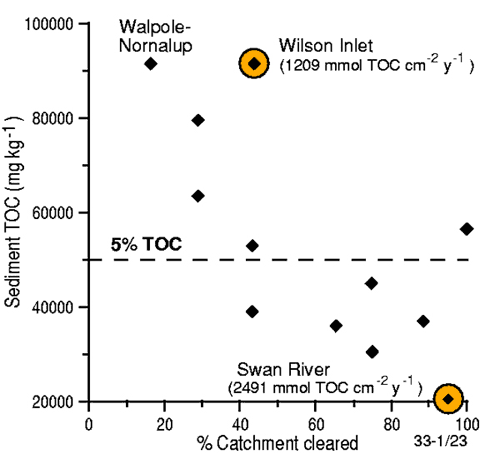
Figure 1. Median TOC concentrations in the sediment of some southwestern Australian estuaries versus percent catchment cleared (from Radke, 2002((Radke, L.C. 2002. Catchment clearing impacts on estuaries. AUSGEO News 65, 6-7.))). Sediment TOC is inversely related to the amount of native vegetation that has been removed from the catchment. This result suggests that (mineral) sediment transport is enhanced by catchment clearing and dilutes organic matter concentrations in the estuaries. Note that the Swan River estuary has considerably lower TOC concentrations than Wilson Inlet, but has more than double the carbon accumulation rate.
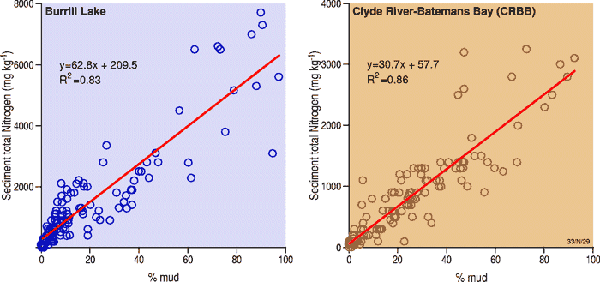
Figure 2. TN concentrations versus % mud for Burrill Lake (a wave-dominated estuary) and Clyde River – Batemans Bay (a drowned river valley) (data from Anderson et al., 1981((Anderson, J. R., Storey, K. J., and Carolane, R. (1981). Macrobenthic fauna and sediment data for eight estuaries on the south coast of New South Wales. Technical Memorandum 81/22, CSIRO Institute of Biological Resources, Division of Land Use Research, Canberra, p7.))) Note: (i) that TN correlates with %mud (e.g. grain size less than 63 um); and (ii) that the slopes are quite different between the two graphs. Burrill Lake has a higher TN content at a given mud percentage than Clyde River – Batemens Bay.
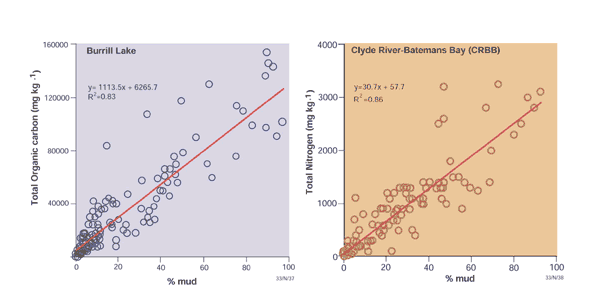
Figure 3. TOC concentrations versus % mud for Burrill Lake (a wave-dominated estuary) and Clyde River – Batemans Bay (a drowned river valley) (data from Anderson et al., 1981((Anderson, J. R., Storey, K. J., and Carolane, R. (1981). Macrobenthic fauna and sediment data for eight estuaries on the south coast of New South Wales. Technical Memorandum 81/22, CSIRO Institute of Biological Resources, Division of Land Use Research, Canberra, p7.))) Note: (i) that TOC correlates with %mud (e.g. grain size less than 63 um); and (ii) that the slopes are quite different between the two graphs. Burrill Lake has a higher TOC content at a given mud percentage than Clyde River – Batemans Bay.
Significance of sediment organic matter
Sediment organic matter can be a source of ‘recycled nutrients’ for water column productivity (including algal blooms) when it degrades. Dissolved oxygen concentrations are usually lowered when organic matter is degraded by aerobic bacteria, and anoxic & hypoxic conditions may develop under stratified conditions.
Organic matter is also a source of food and energy, and its nutritional balance (TOC:TN:TP ratio) plays an important role in material flow through ecosystems. Decomposition rates of organic matter increase as nitrogen and phosphorus contents increase((Goldman, J.C., Caron, D.A. Dennett, M.R. 1987. Regulation of gross growth efficiency and ammonium regeneration in bacteria by substrate C:N ratio. Limnology and Oceanography 32, 1239-1252.)), and as TOC/TN and TOC/TP ratios decrease((Enriquez, S. Duarte, C.M. and Sand-Jensen, K. 1993. Patterns in decomposition rates among photosynthetic organisms: the importance of detritus C:N:P content . Oecologia 94, 457-471.)). ‘Labile’ is the term used to describe organic matter with low TOC:TN ratios (e.g. phytoplankton) that breaks down easily, whereas ‘refractory’ organic compounds (woody debris made of lignin and cellulose) have very high TOC:TN ratios and are highly resistant to degradation. Organic matter with very high TOC:TN ratios consumes more dissolved oxygen((Thomann, R.V. 1972. Systems analysis and water quality measurement. Environmental Research and Application, Inc., New York.)), supports less denitrification((Twilley, R.R., Cowan, J., Miller-Way, T., Montagna, P.A. and Mortazavi, B. 1999. Benthic nutrient fluxes in selected estuaries in the Gulf of Mexico, pp 163-209 In Bianchi, T.S., Pennock, J.R. and Twilley, R.R. (Eds), Biogeochemistry of Gulf of Mexico Estuaries, John Wiley & Sons, Inc.)) and releases fewer nutrients to the water column((Twilley, R.R., Cowan, J., Miller-Way, T., Montagna, P.A. and Mortazavi, B. 1999. Benthic nutrient fluxes in selected estuaries in the Gulf of Mexico, pp 163-209 In Bianchi, T.S., Pennock, J.R. and Twilley, R.R. (Eds), Biogeochemistry of Gulf of Mexico Estuaries, John Wiley & Sons, Inc.)) when it breaks down than organic matter with low TOC:TN ratios. The decomposition of organic matter with very high TOC:TN ratios can even be nutrient-controlled meaning that it can cause the uptake of dissolved inorganic nitrogen (DIN) from the water column((Rivera-Monroy, V.H and Twilley, R.R. 1996. The relative role of denitrification and immobilisation in the fate of inorganic nitrogen in mangrove sediments (Terminos Lagoon, Mexico). Limnology and Oceanography 41, 284-296.)). Sediments with high TOC:TN ratios (and lower N contents) tend to support a lower biomass of benthic invertebrates((Grebmeir, J.M., McRoy, C.P., and Feder, H.M. 1988. Pelagic-benthic coupling on the shelf of the northern Bering and Chukchi Seas. I. Food supply source and benthic biomass. Marine Ecology Progress Series 48, 57-67.)).
Where does sediment organic matter and Nutrients accumulate?
Organic matter has a high affinity for fine-grained sediment because it adsorbs onto mineral surfaces((Hedges, J.I. and Keil, R.G. 1995. Sedimentary organic matter preservation: An assessment and speculative hypothesis. Marine Chemistry 49, 81-115.)). The adsorption process helps to preserve the organic matter((Hedges, J.I. and Keil, R.G. 1995. Sedimentary organic matter preservation: An assessment and speculative hypothesis. Marine Chemistry 49, 81-115.)), and gives rise to a generally positive correlation between TN or TOC and %mud (Figure 2)((Hedges, J.I. and Keil, R.G. 1995. Sedimentary organic matter preservation: An assessment and speculative hypothesis. Marine Chemistry 49, 81-115.)). Sites of organic matter accumulation in coastal waterways are therefore controlled to a large extent by processes that govern the transport and deposition of fine sediment. In tide-dominated waterways (e.g. deltas, estuaries and tidal creeks), flanking environments are the main traps for fine sediments, and these include mangroves, salt marshes and intertidal flats((Heap, A., Bryce, S., Ryan, D., Radke, L., Smith, C., Smith, R., Harris, P. and Heggie, D. 2001. Australian estuaries and coastal waterways: A geoscience perspective for improved and integrated resource management. A report to Theme 7 of the National Land and Water Resources Audit. AGSO Record 2001/07, p. 118.)). Fine sediments also accumulate in mangroves, salt marshes and intertidal flats in wave-dominated coastal waterways (e.g. estuaries and strandplains), but the central basin is usually the main sink((Heap, A., Bryce, S., Ryan, D., Radke, L., Smith, C., Smith, R., Harris, P. and Heggie, D. 2001. Australian estuaries and coastal waterways: A geoscience perspective for improved and integrated resource management. A report to Theme 7 of the National Land and Water Resources Audit. AGSO Record 2001/07, p. 118.)). The baffling of water movement by seagrass leaves can also cause fine sediments to deposit in seagrass meadows.
Considerations for measurement and interpretation
Sediment carbon and nitrogen are best measured by high temperature oxidation methods (e.g. CHN analyser)((Craft, C.B., Seneca, E.D., and Broome, S.W. 1991. Loss on ignition and Kjeldahl digestion for estimating organic carbon and total nitrogen in estuarine marsh soils: calibration with dry combustion. Estuaries 14, 175-179.)), while phosphorus contents are determined by wet chemical oxidation((Nicholls, K.H. 1975. A single digestion procedure for rapid manual determination of Kjeldahl nitrogen and total phosphorus in natural Waters. Anal. Chim. Acta 75, 208-212.)). Appropriate standard reference materials should be analysed to check recovery. The loss on ignition (LOI) method for the determination of sediment TOC is not recommended because it can considerably overestimate TOC concentrations((CSIRO Huon Estuary Study Team. 2000. Huon Estuary Study: Environmental Research for Integrated Catchment Management and Aquaculture. Project No. 96/284, Final Report to the Fisheries Research and Development Corporation, p. 285.)).
Biomarkers (e.g. organic molecules that can be traced to their biological source) and carbon and nitrogen isotopes used in conjunction with TOC:TN ratios can be used to distinguish between algal and terrestrial-plant sources of organic matter. However, TOC:TN ratios and carbon isotopes can be modified during diagenesis, and resulting signatures for algal and terrestrial organic matter can overlap. Comparisons of organic matter should only be made between samples with similar grain size distributions because grain size is an important control on the organic matter content of sediment (Figure 2)((Hedges, J.I. and Keil, R.G. 1995. Sedimentary organic matter preservation: An assessment and speculative hypothesis. Marine Chemistry 49, 81-115.)). Nutrient mass accumulation rates in sediment (nutrient cm-2 year-1) are probably more indicative of nutrient loads than sediment nutrient concentrations because the latter are subject to dilution effects caused by the co-deposition of mineral sediment (Figure 1)((Radke, L.C. 2002. Catchment clearing impacts on estuaries. AUSGEO News 65, 6-7.)). Calculation of nutrient mass accumulation rates requires that sedimentation rates and bulk density be determined in addition to carbon and nutrient concentrations.
Existing information and data
Various data sets can be found in state agencies, commonwealth institutions and universities. Some sediment nutrient (TN & TP) and TOC data was compiled during the National Land and Water Resources Audit((Heap, A., Bryce, S., Ryan, D., Radke, L., Smith, C., Smith, R., Harris, P. and Heggie, D. 2001. Australian estuaries and coastal waterways: A geoscience perspective for improved and integrated resource management. A report to Theme 7 of the National Land and Water Resources Audit. AGSO Record 2001/07, p. 118.)) and is presented in summary form (e.g. medians and 25th and 75th percentiles) in the OzEstuaries database.
NLWRA 2008: Estuarine, coastal and marine habitat condition, indicator guideline
Nutrient concentration in the water column and/or sediments
More information on organic matter (changed from natural) and nutrients (changed from natural).
References
- Nixon, S.W. 1995. Coastal marine eutrophication: A definition, social causes, and future concerns. Ophelia 41, 199-219.
- Froelich, P.N., Klinkhammer, G.P., Bender, M., Leudtke, N.A., Heath, G.R., Cullen, D., Dauphin, P., Hammond, D., Hartman, B., and Maynard, V. 1979. Early oxidation of organic matter in pelagic sediments of the eastern equatorial Atlantic: suboxic diagenesis. Geochimica et Cosmochimica Acta 43, 1075-1090.
- Radke, L.C. 2002. Catchment clearing impacts on estuaries. AUSGEO News 65, 6-7.
- Froelich, P.N. 1988. Kinetic control of dissolved phosphate in natural rivers and estuaries: A primer on the phosphate buffer mechanism. Limnology and Oceanography 33, 649-668.
- Roden, E.E. and Edmonds, J.W. 1997. Phosphate mobilization in iron-rich anaerobic sediments: microbial Fe(III) oxide reduction versus iron-sulfide formation. Arch. Hydrobiol. 139, 347-378.
- Hedges, J.I. and Keil, R.G. 1995. Sedimentary organic matter preservation: An assessment and speculative hypothesis. Marine Chemistry 49, 81-115.
- CSIRO Huon Estuary Study Team. 2000. Huon Estuary Study: Environmental Research for Integrated Catchment Management and Aquaculture. Project No. 96/284, Final Report to the Fisheries Research and Development Corporation, p. 285.
- Goldman, J.C., Caron, D.A. Dennett, M.R. 1987. Regulation of gross growth efficiency and ammonium regeneration in bacteria by substrate C:N ratio. Limnology and Oceanography 32, 1239-1252.
- Enriquez, S. Duarte, C.M. and Sand-Jensen, K. 1993. Patterns in decomposition rates among photosynthetic organisms: the importance of detritus C:N:P content . Oecologia 94, 457-471.
- Thomann, R.V. 1972. Systems analysis and water quality measurement. Environmental Research and Application, Inc., New York.
- Twilley, R.R., Cowan, J., Miller-Way, T., Montagna, P.A. and Mortazavi, B. 1999. Benthic nutrient fluxes in selected estuaries in the Gulf of Mexico, pp 163-209 In Bianchi, T.S., Pennock, J.R. and Twilley, R.R. (Eds), Biogeochemistry of Gulf of Mexico Estuaries, John Wiley & Sons, Inc.
- Rivera-Monroy, V.H and Twilley, R.R. 1996. The relative role of denitrification and immobilisation in the fate of inorganic nitrogen in mangrove sediments (Terminos Lagoon, Mexico). Limnology and Oceanography 41, 284-296.
- Grebmeir, J.M., McRoy, C.P., and Feder, H.M. 1988. Pelagic-benthic coupling on the shelf of the northern Bering and Chukchi Seas. I. Food supply source and benthic biomass. Marine Ecology Progress Series 48, 57-67.
- Heap, A., Bryce, S., Ryan, D., Radke, L., Smith, C., Smith, R., Harris, P. and Heggie, D. 2001. Australian estuaries and coastal waterways: A geoscience perspective for improved and integrated resource management. A report to Theme 7 of the National Land and Water Resources Audit. AGSO Record 2001/07, p. 118.
- Craft, C.B., Seneca, E.D., and Broome, S.W. 1991. Loss on ignition and Kjeldahl digestion for estimating organic carbon and total nitrogen in estuarine marsh soils: calibration with dry combustion. Estuaries 14, 175-179.
- Nicholls, K.H. 1975. A single digestion procedure for rapid manual determination of Kjeldahl nitrogen and total phosphorus in natural Waters. Anal. Chim. Acta 75, 208-212.
- Gerritse, R.G., Wallbrink, P.J., and Murray, A.S. 1998. Accumulation of phosphorus and heavy metals in the Swan-Canning estuary, Western Australia. Estuarine, Coastal and Shelf Science 47, 165-179.
- Kristensen, E,. and Ahmed, S.I. and Devol, A.H. 1995. Aerobic and anaerobic decomposition of organic matter in marine sediment: Which is faster? Limnology and Oceanography 40(08), 1430-1437.
- Harnett, H.E., Keil, R.G. Hedges, J.I., and Devol, 1998. Influence of oxygen exposure time on organic matter preservation in continental margin sediments. Nature 391, 572-574.
- Pierson, W.L., Bishop, K., Van Sendon, D., Horton, P.R., and Adamantidis, C.A. 2002. Environmental Water Requirements to Maintain Estuarine Processes, Environmental Flows Initiative Technical Report, Report Number 3, Commonwealth of Australia.
- Anderson, J. R., Storey, K. J., and Carolane, R. (1981). Macrobenthic fauna and sediment data for eight estuaries on the south coast of New South Wales. Technical Memorandum 81/22, CSIRO Institute of Biological Resources, Division of Land Use Research, Canberra, p7.
Contributors
Graham Logan, Geoscience Australia
Andy Longmore, Marine and Freshwater Research Institute, Queenscliff.