What are saltmarshes?
A coastal saltmarsh is a community of plants and animals that grow along the upper-intertidal zone (above the mean spring-tide height) of coastal waterways((Heap, A., Bryce, S., Ryand, D., Radke, L., Smith, C., Smith, R., Harris, P. and Heggie, D. 2001. https://data.gov.au/dataset/australian-estuaries-and-coastal-waterways-a-geoscience-perspective-for-improved-and-integrated. AGSO Record 2001/07, pp. 118.)), mainly in temperate regions (see photo 1). Saltmarshes are habitats for communities of salt-tolerant vegetation (halophytes including: grasses, herbs, reeds, sedges and shrubs), a wide range of infaunal and epifaunal invertebrates, and low-tide and high-tide visitors such as fish and water birds. The diversity of saltmarsh plant species increases with increasing latitude. This contrasts with mangrove diversity, which is highest in the lower latitudes of the tropics. In Australia, when saltmarshes and mangroves coexist, saltmarshes are typically found at higher elevations where they are inundated less frequently than mangroves((Saintilan, N., Rogers, K. and McKee, K. 2007. Saltmarsh-Mangrove Interactions. In Press)). However, this is not always true in an international context. When seagrass beds are found adjacent to saltmarshes and mangroves, many material links and shared plant and animal communities can exist((Fortes, M. 1994. Seagrass resources of ASEAN. In Living Coastal Resources of Southeast Asia: Status and Management, Vol. I, pp 106-112.)).
Saltmarsh sediments generally consist of poorly-sorted anoxic sandy silts and clays. Carbonate concentrations are generally low, and concentrations of organic material are generally high. As with saltflats (see below) the sediments may have salinity levels that are much higher than that of seawater. These sediments are also usually anoxic and have large accumulations of iron sulfides((King, G.M. 1983. Sulfate reduction in Georgia salt marsh soils: an evaluation of pyrite formation by use of “SUP 35” S and “SUP 55” Fe tracers. Limnology and Oceanography 28, 987-995.)). Disturbing these acid sulfate soils can cause sulfuric acid to drain into coastal waterways. Saltmarshes are often associated with saltflats (described below) or exposed bare areas.
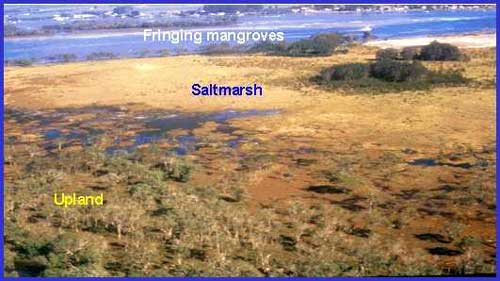
Photo 1. salt marsh on Tabby Tabby Island, Moreton Bay Qld. (photo by Pat Dale, Griffith University)
What are saltflats?
Saltflats, or saline supratidal mudflat facies, occur in dry evaporative environments (often in the tropics) that undergo infrequent tidal inundation. Sediments comprise poorly-sorted sandy silts and clays, including mineral deposits such as gypsum and halite which form crusts (see photo 2). Saltflats tend to be low gradient, and mostly featureless, with a varying degree of algal colonisation, and often with vertically accreting algal mats. They generally occur above mean high water spring, and experience infrequent inundation by king tides. The high salinity levels (surface and groundwater) in these environments often preclude the growth of higher vegetation and biota (some infauna and epifauna may occur at lower elevations). Saltflats are habitats for birds, particularly during the wet season.
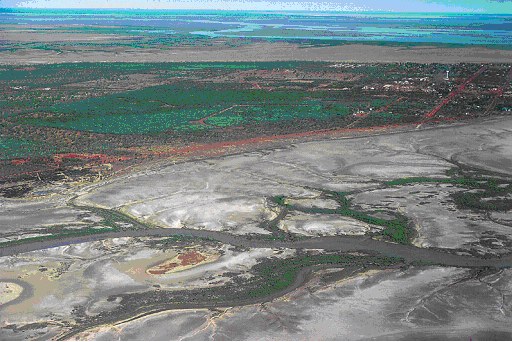
Photo 2. Saltflat environments on supra-tidal flats of King Sound near Derby (photo by Norm Duke).
The importance of salt marsh areas
Salt marshes are important because they fulfil a variety of vital roles in processes operating in coastal systems((Dale, P.E.R. & Hulsman, K. (1990) A critical review of salt marsh management methods for mosquito control. Crit. Rev. in Aquatic Science, 3; 281-311.)).
Biological importance
- Important for estuarine food chains; primary productivity and a support resource for estuarine food webs((Cappo, M., Alongi, D.M., Williams, D, and Duke, N. 1995. A review and synthesis of Australian Fisheries Habitat Research: Major threats, issues and gaps in knowledge of coastal and marine fisheries habitats (and references within). Fisheries Research and Development Corporation.)). They are an important food source for juvenile fish and crustaceans((Mazumder, D., Saintilan, N. and Williams, R.J. 2006. Trophic relationships between itinerant fish and crab larvae in a temperate Australian saltmarsh. Marine and Freshwater Research 57, 193-199.)).
- Mediates a balance of nutrients and organic matter between salt marsh and other interacting systems including mangroves, seagrass beds and open water systems((Cappo, M., Alongi, D.M., Williams, D, and Duke, N. 1995. A review and synthesis of Australian Fisheries Habitat Research: Major threats, issues and gaps in knowledge of coastal and marine fisheries habitats (and references within). Fisheries Research and Development Corporation.)); it acts as an ecological buffer.
- Provides a protected habitat for both marine and terrestrial organisms, some of which are endangered and protected.
Physical importance
- Protection of coastlines from the erosive effects of storms and extreme tides.
- Traps and binds sediment aiding in the process of land making((Cappo, M., Alongi, D.M., Williams, D, and Duke, N. 1995. A review and synthesis of Australian Fisheries Habitat Research: Major threats, issues and gaps in knowledge of coastal and marine fisheries habitats (and references within). Fisheries Research and Development Corporation.)).
- Hydrologic support – water quality and maintenance of groundwater.
Economic((Gosselink, J. G., Odum, E. P. and Pope, R. M. (1974) The Value of the Tidal Marsh, Louisiana State University Centre for Wetland Resources Publ. LSC1-SG-74-03, Baton Rouge.))
- Saltmarshes are farmed as grazing leases for cattle production.
- Landforms of commercial value for development, although this is often at the expense of the saltmarsh.
- Important food source for commercially important fish((Mazumder, D., Saintilan, N. and Williams, R.J. 2006. Trophic relationships between itinerant fish and crab larvae in a temperate Australian saltmarsh. Marine and Freshwater Research 57, 193-199.))
- Value of ecosystem services such as the price one would pay for the water treatment function of wetlands.
- Salt mining for commercial uses (photo 3).
Human values
- Teaching and research and their contribution to intellectual wealth.
- Aesthetics: increasingly salt marshes are being valued more highly for their aesthetic appeal, especially when found in a more natural state.
- Recreation activities such as bird watching.
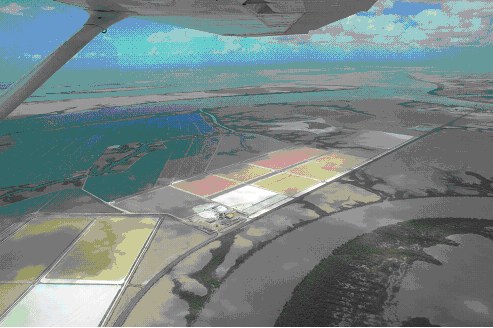
Photo 3 Evaporation ponds and saltfalt environments on the supra-tidal flats of the Fitzroy Estuary adjacent to Casuarina Creek in Queensland (photo by Brendan Brooke). The salt that is mined in this region is used in salt-water pools and for general use.
What causes saltmarsh areas to change?
Shoreline development and changes in local hydrology are the biggest threats to the saltmarsh habitat and some of the specific threats include:
- Clearing for solar salt production
- Landfill or reclamation associated with industrial, housing, port developments, road construction, sporting complexes, marinas, canals and resorts((Cappo, M., Alongi, D.M., Williams, D, and Duke, N. 1995. A review and synthesis of Australian Fisheries Habitat Research: Major threats, issues and gaps in knowledge of coastal and marine fisheries habitats (and references within). Fisheries Research and Development Corporation.)).
- Damage by trampling((Adam, P. 1994. salt marsh and mangrove. Australian Vegetation (ed. by R.H. Groves), 2nd Edition, Cambridge University Press, pp. 395-435.)), grazing, rubbish dumping and the effects of storm water drainage ((Cappo, M., Alongi, D.M., Williams, D, and Duke, N. 1995. A review and synthesis of Australian Fisheries Habitat Research: Major threats, issues and gaps in knowledge of coastal and marine fisheries habitats (and references within). Fisheries Research and Development Corporation.)). Some of the effects include additions of nutrients, sediments, pollutants (including oil((Pereira, M.G., Mudge, S.M., Latchford, J. 2002. Consequences of linseed oil spills in salt marsh sediments. Marine Pollution Bulletin 44, 520-533.)) ), weeds and freshwater run-off. Run-off from urban areas alters the natural salinity regime, promoting the spread of freshwater and brackish plant species((Cappo, M., Alongi, D.M., Williams, D, and Duke, N. 1995. A review and synthesis of Australian Fisheries Habitat Research: Major threats, issues and gaps in knowledge of coastal and marine fisheries habitats (and references within). Fisheries Research and Development Corporation.)).
- Saltmarsh modifications that alter the tidal flooding pattern may transport mangrove propagules into saltmarsh areas, potentially facilitating colonisation((Breitfuss, M.J., Connolly, R.M., and Dale, P.E.R. 2002. Mosquito-control runnels facilitate transport of Avicennia marina propagules to salt marshes in southeast Queensland.Proceedings of the annual conference of the Australian Marine Sciences Association, 10-12 July 2002, Fremantle WA.)).
- Increased tidal amplitudes, which can cause the expansion of mangroves into saltmarsh areas (Photo 4)((Saintilan, N. and Williams, R.J. 1999. Mangrove transgression into salt marsh environments in south-east Australia. Global Ecology and Biogeography 8, 117-124.)). Increased tidal amplitudes may result at a local scale from estuary entrance engineering works, which alter tidal exchange. At a regional scale, expansion of mangrove into saltmarsh in southeastern Australia may be due to other forcing factors such as sea-level rise((Saintilan, N. and Williams, R.J. 1999. Mangrove transgression into salt marsh environments in south-east Australia. Global Ecology and Biogeography 8, 117-124.)) (see below).
- Regional scale changes in air temperature and rainfall, which may alter the hydrology and salinity of an area ((Saintilan, N. and Williams, R.J. 1999. Mangrove transgression into salt marsh environments in south-east Australia. Global Ecology and Biogeography 8, 117-124.)).
Saltmarsh areas and sea-level rise
Due to the identification of regional trends of mangrove expansion into saltmarsh areas and corresponding declines in saltmarsh extent, there has been considerable interest in the relationship between saltmarsh decline and sea-level changes associated with global warming((Saintilan, N. and Williams, R.J. 1999. Mangrove transgression into salt marsh environments in south-east Australia. Global Ecology and Biogeography 8, 117-124.))((Rogers, K., Wilton, K..M. and Saintilan, N. 2006. Vegetation change and surface elevation dynamics in wetlands of southeast Australia. Estuarine, Coastal and Shelf Science 66, 559-569.)). Intertidal vegetation, such as saltmarsh, may respond to sea-level rise by migrating upslope, or increasing their elevation through processes of vertical accretion or sedimentation so that they remain within the same tidal range((Vanderzee, M.P. 1988. Changes in saltmarsh vegetation as an early indicator of sea-level rise. In Greenhouse: Planning for climate change (Ed. G.I. Pearmann). Commonwealth Scientific and Industrial Research Organisation (CSIRO), Melbourne, Australia.)). Without such a response, shoreline contraction of saltmarsh may occur due to erosion, or submergence and death((Reed, D.J. 1995. The response of coastal marshes to sea-level rise: survival or submergence? Earth Surface Processes and Landforms 20, 39-48.)).
Since the response of saltmarshes to sea-level rise are numerous and vary depending on the rate and degree of sea-level rise, identifying links between saltmarsh decline and sea-level rise are difficult. By coupling analyses of change in saltmarsh extent with ground-based analyses of vertical accretion and surface elevation change, linkages between changes in extent and sea-level rise can be identified((Rogers, K., Wilton, K..M. and Saintilan, N. 2006. Vegetation change and surface elevation dynamics in wetlands of southeast Australia. Estuarine, Coastal and Shelf Science 66, 559-569.)).
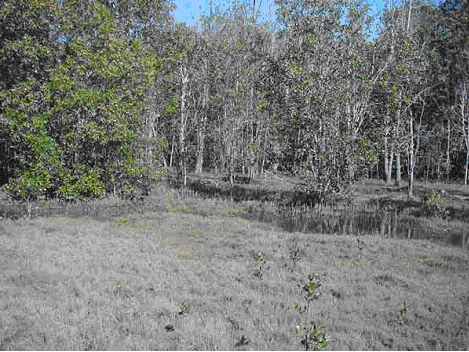
Photo 4. An Avicennia mangrove encroaching into a saltmarsh area (photo by Jon Knight, UQ)
Saltmarsh/saltflat areas as environmental indicators
Changes in the distribution of saltmarshes and mangroves have been identified as an important indicator of environmental change for State of the Environment Reporting((Ward, T., Butler, E. and Hill, B. 1998. Environmental Indicators for National State of the Environment Reporting, Estuaries and the Sea, Commonwealth of Australia, pp. 81.)), and have been more recently proposed as a means to monitor change in coastal environments as indicators of global warming ((Vanderzee, M.P. 1988. Changes in saltmarsh vegetation as an early indicator of sea-level rise. In Greenhouse: Planning for climate change (Ed. G.I. Pearmann). Commonwealth Scientific and Industrial Research Organisation (CSIRO), Melbourne, Australia.)), climate change, storm effects, sea level change, pollution and sedimentation rates. The results of a recent study suggest that the proportional areas of salt flats in Australian tide-dominated coastal waterways are decreasing due to enhanced sediment loads from disturbed catchments (Figure 1).
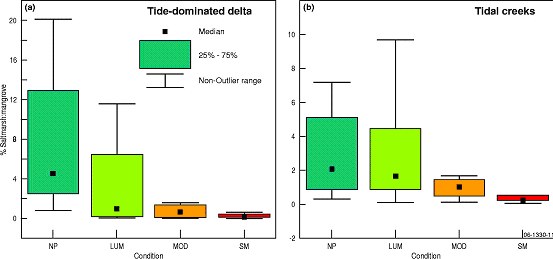
Figure 1. Box and whisker diagrams show medians, 25th and 75th percentiles and ranges in the ratio of saltmarsh+saltflat:mangroves areas in Research Data Australiatidal creeks from across Australia((Radke, L., Brooke, B., Ryan, D. Lahtinen, A. and Heap, A. 2006. An initial assessment of estuarine geomorphic indicators of coastal waterway health – Final Report Cooperative Research Centre for Coastal Zone, Estuary & Waterway Management Technical Report #66.)). The breakdown of the data is in accordance with the Research Data Australia of the first National Land and Water Resources Audit (NLWRA), in which NP is near-pristine; LUM is largely unmodified; MOD is modified; and SM is severely modified. The extent to which coastal waterways have filled with sediment is indicative of different degrees of Research Data Australia, which gives rise to different configurations of habitats. In the relatively modified estuaries, more of the accommodation space for sediment has been filled, which is evidenced by an increase in the relative areas of inter- and near-tidal habitats (i.e. mangroves and intertidal flats). This infill gives rise to a concomitant proportional decrease in saltmarsh+salt flat areas, and also a change in the saltmarsh+saltflat:mangrove ratio. The fact that in most cases these “maturity” changes coincide with diminishing NLWRA condition status suggests that some estuaries are experiencing more rapid infilling as a result of enhanced sediment loads from catchments that have lost a significant proportion of their native vegetation.
Considerations for measurement and interpretation
Aerial photography and satellite imagery can be used to map the extent of salt marshes. Ground truthing by local agencies is advised to differentiate between salt marsh and saltflat areas. the Department of Environment, Water, Heritage and the Arts provide guidelines for State of the Environment reporting((Ward, T., Butler, E. and Hill, B. 1998. Environmental Indicators for National State of the Environment Reporting, Estuaries and the Sea, Commonwealth of Australia, pp. 81.)).
Existing information and data
Mangroves and coastal saltmarsh of Victoria: Distribution, condition, threats and management comprises the first State-wide assessment of the wetlands that fringe the coast of Victoria. The 514 page report examines the diversity of wetland types and plant communities along the Victorian coast and provides analysis of the ecological condition and major threats to coastal wetlands in Victoria. It also includes the first fine-scale mapping of all current mangrove and saltmarsh wetlands in Victoria.
Interactive Habitat Extent and Distribution Mapping Interface. The National Intertidal/Sub-tidal Benthic Habitat Classification scheme (NISB) habitat classes include: mangroves, saltmarsh, seagrass, macroalgae, coral reef, rock-dominated, sediment-dominated and filter feeders (such as sponges). These habitats occur between the approximate position of the highest astronomical tide mark and the location of the outer limit of the photic benthic zone (usually at the 50 to 70 metre depth contour). High spatial resolution polygons with thematic attributes based on NISB are available in the NRM Reporting module, together with national, state and regional summary maps for each habitat.
The OzCoasts database contains mapped areas for salt marsh+saltflat (see Nassau River example below, Figure 2) for a large number of Australian estuaries collected as part of the National Land and Water Resources Audit (NLWRA). This data set represents one of the largest internally consistent data sources. Accurate mapping has been undertaken by a number of state and local governments and academic institutions. For example, Queensland Government – Department of Agriculture & Fisheries (CHRIS) has an interactive map facility that enables users to make detailed vegetation maps for the Queensland coast (see coastal wetland layers) in including saltmarsh/saltflat areas (Figure 3).
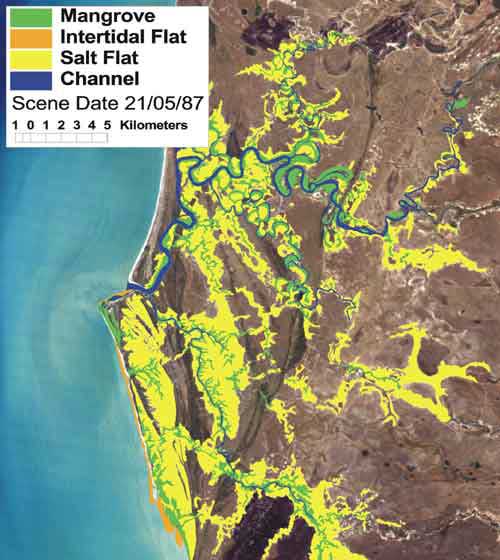
Figure 2. salt marsh + saltflat areas (yellow) in the Nassau River (QLD)
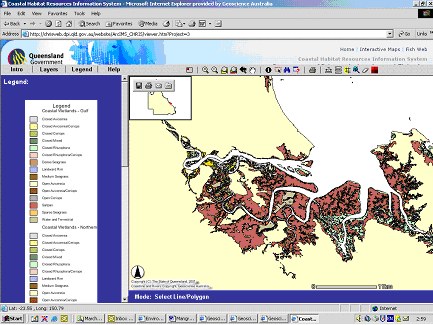
Figure 3. Screen dump showing detailed vegetation map for tidal creeks near the Fitzroy Estuary and Keppel Bay based on CHRIS.
More information on habitat removal/disturbance.
Key questions
Exchanges between Australian marshes and adjacent ecosystems are poorly understood, as are salt marsh faunas, productivity and energy and nutrient flows((Cappo, M., Alongi, D.M., Williams, D, and Duke, N. 1995. A review and synthesis of Australian Fisheries Habitat Research: Major threats, issues and gaps in knowledge of coastal and marine fisheries habitats (and references within). Fisheries Research and Development Corporation.)). Research that addresses links with fisheries, opportunities for weed control and effects of pollution, vehicle tracks and insecticides on marshes is urgently required((Cappo, M., Alongi, D.M., Williams, D, and Duke, N. 1995. A review and synthesis of Australian Fisheries Habitat Research: Major threats, issues and gaps in knowledge of coastal and marine fisheries habitats (and references within). Fisheries Research and Development Corporation.)).
Contributors
Pat Dale, Griffith University
Jon Knight, University of Queensland
Mark Breitfuss, Australian School of Environmental Studies, Griffith University
Lynda Radke, Geoscience Australia
Kerrylee Rogers, NSW Department of Environment and Conservation