What is the benthic carbon dioxide flux?
The benthic carbon dioxide flux refers to the amount of carbon dioxide (CO2) released from a unit area of sediment over a specific time interval, during the decomposition of organic matter.
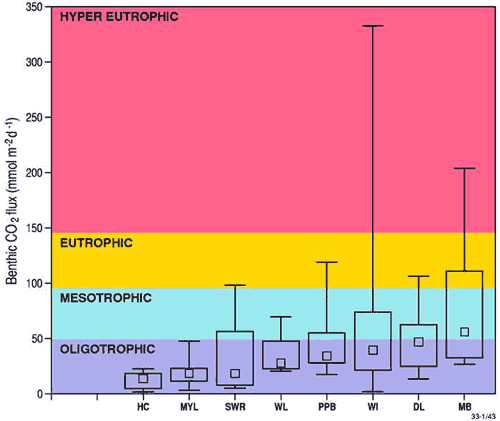
Figure 1. Box and whisker diagram showing median, ranges and 25th and 75th percentiles for benthic CO2 fluxes for some coastal waterways from around Australia. The data was extracted from the Search Data module. Abbreviated names are as follows: Hinchinbrook Channel (HC); Myall Lake (MYL); Swan River (SWR); Wallis Lake (WL); Port Phillip Bay (PPB); Wilson Inlet (WI); Durras Lake (DL); and Moreton Bay (MB). Note that most waterways have median values that are in the oligotrophic range, based on the criteria of Eyre (2002)1.
What causes the benthic carbon dioxide flux to change?
- Organic matter loadings to sediment (a.k.a. trophic status) are usually the main control on the magnitudes of the benthic CO2 fluxes.
- Part of the benthic CO2 flux may also result from the dissolution of calcium carbonate: e.g. CaCO3 + H2O + CO2 = Ca2+ + 2HCO3-.
Significance of the benthic carbon dioxide flux
Managers need reliable criteria to define acceptable nutrient loads to coastal waterways in order to effectively manage eutrophication1. Such criteria are best based on carbon loadings (rather than nutrient loadings) because excess nutrients alter the delicate balance between carbon production and metabolism12. The benthic CO2 flux is a proxy of organic carbon loading to sediment, and is inversely correlated to denitrification efficiency and benthic p/r ratio in some wave-dominated estuaries in southeastern Australia1. Fluxes of <45.6 mmol m-2 d-1, 45.6-91.3 mmol m-2 d-1, 91.3-137 mmol m-2 d-1 and >137 mmol m-2 d-1, in these systems, are indicative of oligotrophic, mesotrophic, eutrophic and hypertrophic conditions, respectively1 (Figure 1).
The efflux of carbon dioxide from the sediment contributes to water column PCO2, which strongly influences whether a waterway is net autotrophic or net heterotrophic. It also affects water column pH and hardness because changes in dissolved CO2 concentrations influence the saturation state of calcium carbonate.
Considerations For Measurement and Interpretation
The efflux of CO2 from sediment is determined using benthic chambers. Benthic chambers are open-bottom containers (usually constructed out of perspex) that enclose an area of sediment and overlying water. The chambers are deployed on the sediments/substratum, to capture gas and solute movement between the sediment and the water column. Total CO2 is measured on a Dissolved Inorganic Carbon (DIC) Analyser or is calculated from pH and alkalinity3.
Existing Information And Data
Benthic CO2 flux data for a small number of Australian coastal waterways were compiled during the National Land and Water Resources Audit. These data and some more recent CO2 flux data are available in the Search Data module.
More information on organic matter (changed from natural).
- Eyre, B. and A.J.P. Ferguson, 2009. Denitrification efficiency for defining critical loads of carbon in shallow coastal ecosystems. Hydrobiologia 629(1), 137-146. (DOI 10.1007/s10750-009-9765-1 ↩ ↩ ↩ ↩ ↩
- Nixon, S.W. (1995). Coastal marine eutrophication: A definition, social causes, and future concerns. Ophelia 41, 199-219. ↩
- Grasshoff, K., Ehrnhardt, M., Kremling, K. (1983). Methods of seawater analysis . Verlag Chemie, Weinheim. ↩